
GRP vs SMC vs Zincalume Water Tanks: Which Is Best for Industrial Use in India?
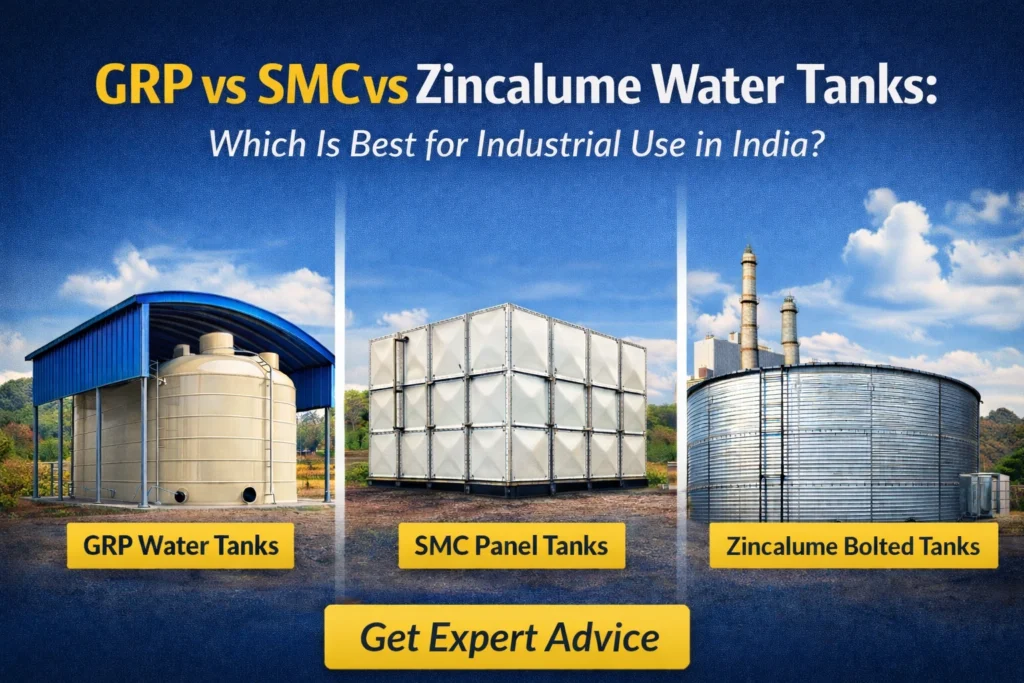
Choosing the right industrial water storage tank is crucial for ensuring durability, operational efficiency, and long-term cost savings. With multiple options available in the market, including GRP water tanks, SMC panel tanks, and zincalume bolted tanks, businesses often struggle to decide which solution best suits their needs. This comprehensive guide compares these three popular water storage systems to help industries, commercial facilities, and infrastructure projects in India make the right investment decision. Why Choosing the Right Industrial Water Tank Matters Industrial water tanks are long-term infrastructure assets. Selecting the wrong type can lead to: The right tank ensures:✔ Long service life✔ Reliable water supply✔ Compliance with safety standards✔ Lower total cost of ownership Overview of the Three Major Tank Types 1. GRP Water Tanks (Glass Reinforced Plastic) GRP tanks are manufactured using fiberglass-reinforced plastic, offering high strength with lightweight construction. Key Features Best For: Chemical plants, commercial buildings, municipal water storage 2. SMC Panel Water Tanks SMC tanks are built using modular panels assembled on-site, allowing customization and scalability. Key Features Best For: Hospitals, high-rise buildings, large industrial units 3. Zincalume Bolted Water Tanks These tanks are made from zincalume-coated steel sheets bolted together on-site. Key Features Best For: Industrial estates, firefighting systems, infrastructure projects Detailed Comparison: GRP vs SMC vs Zincalume Tanks Feature GRP Tanks SMC Panel Tanks Zincalume Bolted Tanks Durability High High Very High Corrosion Resistance Excellent Excellent Very Good Weight Lightweight Moderate Heavy Installation Easy Moderate Longer Customization Limited High High Maintenance Low Low Low Lifespan 15–20 years 15–20 years 20+ years Best Use Commercial/Industrial Large buildings Heavy-duty projects Which Tank Is Best for Your Industry? Choose GRP Tanks If You Need: ✔ Corrosion resistance✔ Lightweight structure✔ Low maintenance✔ Cost-effective solution Ideal industries: chemical plants, food processing units, commercial complexes Choose SMC Panel Tanks If You Need: ✔ Custom sizes✔ Installation in restricted spaces✔ Modular expansion✔ Leak-proof performance Ideal industries: hospitals, high-rise buildings, data centers Choose Zincalume Bolted Tanks If You Need: ✔ Heavy-duty durability✔ Large-scale storage✔ Long lifespan✔ Firefighting compliance Ideal industries: manufacturing plants, industrial parks, municipal projects Environmental Considerations in India India’s climate varies from extreme heat to heavy monsoons. Tank selection should consider: GRP and SMC tanks perform well in corrosive and humid environments, while zincalume tanks excel in large outdoor installations. Cost Comparison While prices vary based on capacity and customization: Remember: lowest upfront cost ≠ best long-term value. Role of Prefab Shelters in Enhancing Tank Life Regardless of tank type, prefab shelters provide:✔ Protection from UV and rain✔ Reduced contamination risk✔ Lower maintenance costs✔ Extended tank lifespan Installing prefab shelters is a smart investment for long-term performance. Common Mistakes Buyers Should Avoid ❌ Choosing tanks based only on price❌ Ignoring future capacity needs❌ Overlooking environmental conditions❌ Skipping protective shelters❌ Hiring inexperienced installers Avoiding these mistakes ensures better performance and ROI. Why Industries Trust Trident Infratech Trident Infratech delivers high-quality water storage solutions tailored to diverse industrial and commercial needs across India. Our Solutions Include What Sets Us Apart ✔ Advanced engineering & premium materials✔ Custom-built solutions✔ Quick installation support✔ Long-term reliability✔ Nationwide service network Conclusion: Which Tank Should You Choose? There is no one-size-fits-all solution. The best water tank depends on your application, environment, and capacity needs: Consulting experts ensures you select the most efficient and cost-effective solution. Need Help Choosing the Right Water Tank? Contact Trident Infratech today for expert guidance and customized industrial water storage solutions. 📞 Request a free consultation and secure your water infrastructure today.
Complete Buyer’s Guide to Water Storage Solutions in India (2026)
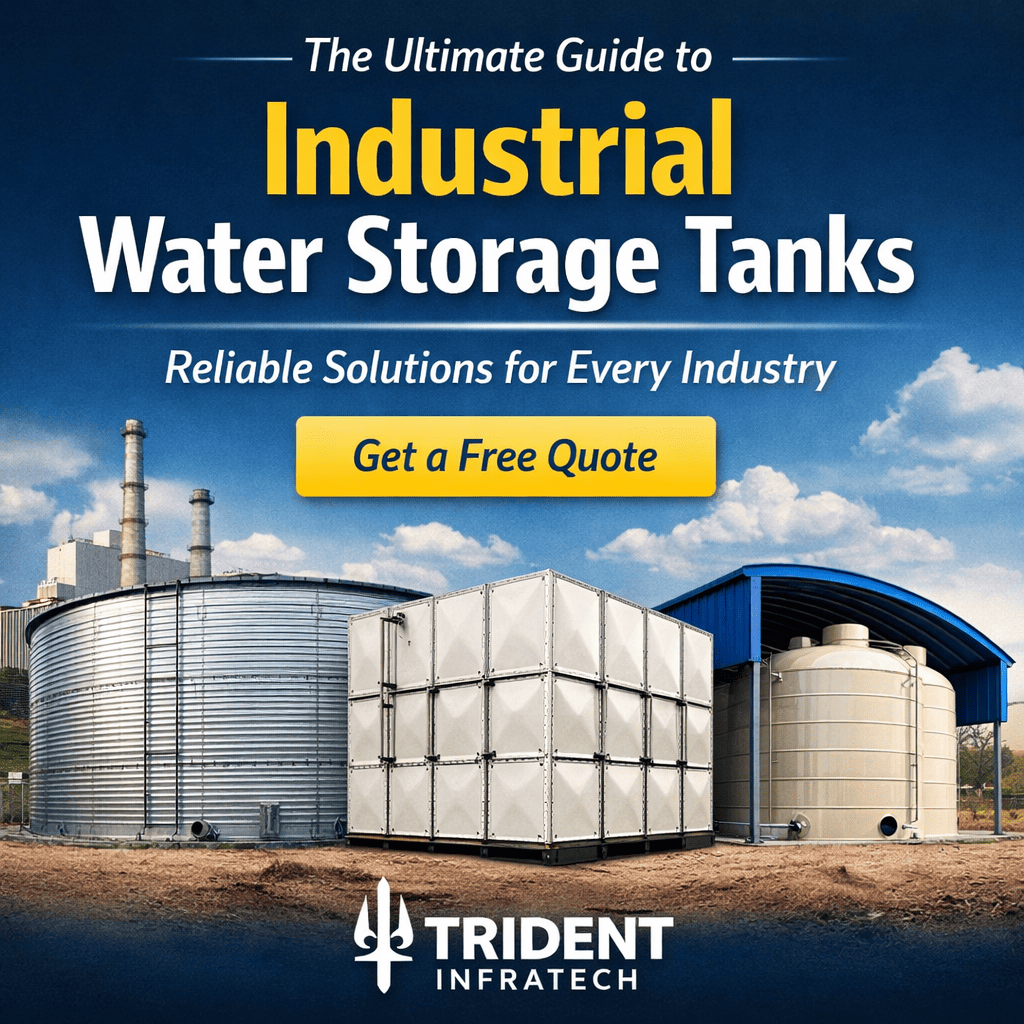
Water storage systems are essential for industries, commercial facilities, agriculture, firefighting systems, and urban infrastructure. Choosing the right water storage solution can significantly impact performance, durability, cost savings, and long-term operations. This ultimate 2026 buyer’s guide helps you understand:✔Types of water storage tanks✔ Key features to look for✔ Which solutions fit your needs✔ Cost considerations✔ Installation & maintenance tips✔ How Trident Infratech stands out Let’s dive in! Why Water Storage Solutions Matter in 2026 India’s rapid industrial growth, expanding urbanization, unpredictable weather, and increased water scarcity have made efficient water storage systems a business priority. Whether it’s uninterrupted industrial water supply, agriculture irrigation, emergency firefighting reserves, or municipal storage, selecting the right tank solution ensures:✔ Reliable supply✔ Long service life✔ Lower operational cost✔ Better water quality Types of Water Storage Solutions 1. GRP Water Tanks GRP (Glass Reinforced Plastic) tanks are lightweight yet strong, corrosion-resistant, and suitable for multiple applications. Benefits✔ Rust-proof✔ Long-lasting performance✔ Low maintenance Best for: Industrial, commercial, municipal & corrosive environments 2. SMC Panel Tanks SMC (Sheet Moulding Compound) tanks are modular, easy to install, and compatible with complex site layouts. Benefits✔ Quick installation✔ Customizable size✔ Excellent mechanical strength Best for: Large capacity storage & restricted space sites 3. Flexi Tanks Flexible and portable storage, perfect for temporary or movable water needs. Benefits✔ Lightweight and portable✔ Easy transport & setup✔ Ideal for temporary or remote sites Best for: Construction, agriculture, disaster relief 4. Zincalume Bolted Tanks Made from high-grade zincalume steel plates that are bolted on-site. Benefits✔ Extremely durable✔ Weather resistant✔ Scalable to very large capacities Best for: Industrial estates, firefighting reserves, large facility storage 5. JioAqua Tanks Designed for efficient water conservation and urban requirements. Benefits✔ Sustainable storage solution✔ Structured design for municipal use✔ Suitable for residential and commercial complexes Best for: Urban water supply, housing complexes 6. Prefab Shelters While not a tank type, prefab shelters protect your tanks against weather and contamination, improving longevity and performance. Key Benefits✔ Shield against sun, rain & dust✔ Lower maintenance needs✔ Better water hygiene Key Factors to Consider Before Buying 1. Purpose of Storage Ask:✔ Is it for drinking water?✔ Industrial use?✔ Firefighting backup?✔ Agriculture irrigation? Your use case influences material, size, and design. 2. Capacity Requirements Calculate:✔Daily water needs✔Peak usage estimate✔Future expansion Oversizing leads to cost waste, while undersizing restricts capacity. 3. Material & Durability Different tank materials suit different environments:✔ GRP: Corrosion resistant✔ SMC: Modular & strong✔ Zincalume: Heavy-duty✔ Flexi: Flexible & portable 4. Environmental Conditions Heat, monsoon moisture, corrosive chemicals, and dust levels impact tank wear. Choose materials that withstand your local climate conditions. 5. Installation & Space Constraints Some tanks (like SMC or bolted) require room for assembling on site, while others are prefabricated. Consider site accessibility and installation time. 6. Budget & ROI Quality tanks cost more upfront but save money over time via:✔ Lower repair costs✔ Longer service life✔ Reduced downtime Always evaluate total cost of ownership. Comparison of Water Storage Tank Types Tank Type Durability Cost Installation Best Use Case GRP Tanks High Medium Easy Industrial/Commercial SMC Panel High Medium Moderate Large capacity, Custom Flexi Tanks Medium Low Very Easy Temporary & Mobile Bolted Zincalume Very High High Longer Heavy-Duty, Large Projects JioAqua Tanks Medium-High Medium Easy Urban/Municipal Prefab Shelters Adds protection Varies Easy Enhances durability Installation Checklist Before installation, ensure:✔ Site leveled & accessible✔ Foundation strength verified✔ Proper outlet & drainage planned✔ Pipes and fittings compatible✔ Safety protocols observed Maintenance Tips for Longevity Maintenance is essential for peak performance:✔Inspect seals and joints regularly✔Clean interiors annually✔Check external coatings & covers✔Ensure proper drainage to prevent stagnation✔Protect from direct sunlight and dust Why Choose Trident Infratech? Trident Infratech is a leading provider of high-quality, durable, and cost-effective water storage solutions for every industry and application in India. Our Advantages ✔ Custom engineered water tanks✔ Premium materials & manufacturing✔ State-of-the-art technology✔ Expert installation support✔ National coverage & after-sales service We specialize in: Each solution ensures reliability, long life, and optimum performance — designed for India’s diverse needs. Conclusion Choosing the right water storage solution in 2026 means understanding your specific needs, evaluating tank features, and selecting durable, cost-effective systems. Whether you require industrial strength, portability, or municipal compliance, this guide provides everything you need to make a confident decision.
Smart Water Storage Solutions in India: Building a Sustainable Future with Trident Infratech
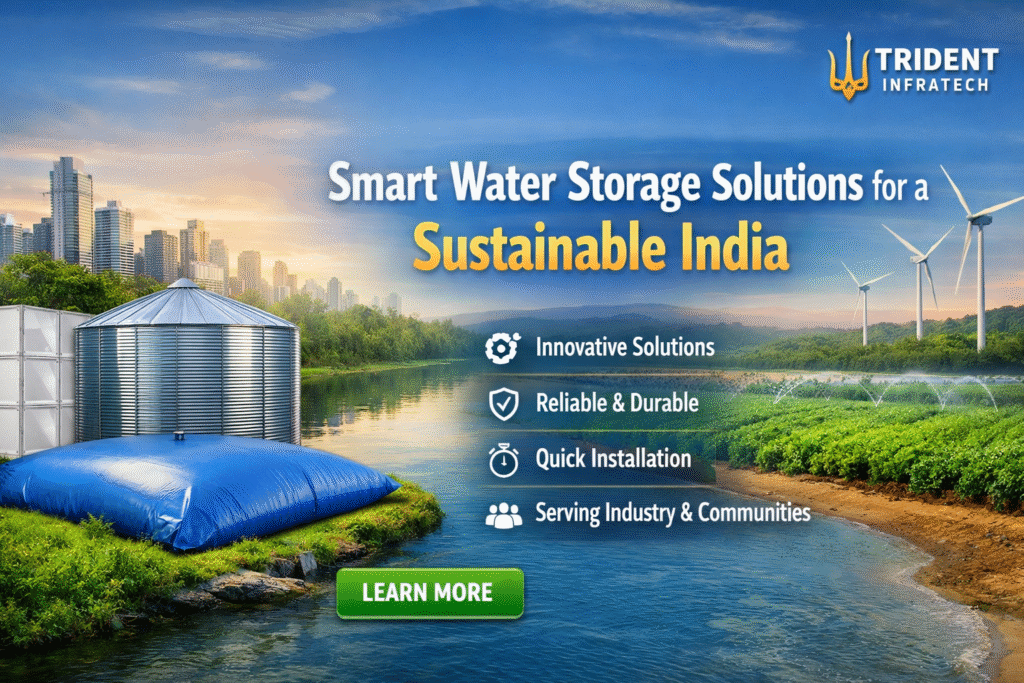
Introduction: Water Storage – A Critical Need for Modern India Water is one of the most valuable resources for any nation, and for a rapidly developing country like India, efficient water storage and management have become more important than ever. Increasing urbanization, industrial expansion, agricultural demands, and climate uncertainty are putting immense pressure on existing water infrastructure. Traditional storage systems are no longer sufficient to meet modern requirements. This is where advanced water storage solutions play a vital role. From industrial facilities and commercial complexes to agricultural fields and community projects, reliable water storage infrastructure ensures uninterrupted supply, operational efficiency, and long-term sustainability. Trident Infratech stands at the forefront of this transformation, delivering innovative, durable, and scalable water storage solutions tailored to India’s diverse needs. Understanding Modern Water Storage Challenges India faces several water-related challenges that demand smarter infrastructure solutions: To address these challenges, modern water storage systems must be strong, flexible, corrosion-resistant, cost-effective, and quick to deploy. Trident Infratech: Trusted Solutions for Every Drop of Water At Trident Infratech, water storage is not just about tanks—it is about creating long-lasting infrastructure that supports growth and sustainability. With years of experience and a strong project portfolio, the company provides comprehensive solutions for: Their solutions are engineered to meet Indian climatic conditions while adhering to quality and safety standards. Comprehensive Range of Water Storage Solutions 1. SMC Panel Tanks SMC (Sheet Moulding Compound) Panel Tanks are one of the most reliable water storage systems for industrial and commercial use. Key Benefits: SMC panel tanks are widely used in hospitals, residential societies, factories, and commercial buildings where hygiene and reliability are essential. 2. GRP Panel Tanks GRP (Glass Reinforced Plastic) Panel Tanks are designed for long-term performance with minimal maintenance. Advantages include: These tanks are ideal for large-scale applications such as hotels, IT parks, industrial plants, and infrastructure projects. 3. Zincalume Bolted Tanks For projects that demand strength, scalability, and durability, Zincalume Bolted Tanks offer a perfect solution. Why choose Zincalume tanks? They are commonly used in municipal projects, fire protection systems, industrial water storage, and agricultural applications. 4. Flexi Tanks Flexi Tanks represent the future of temporary and mobile water storage solutions. Key Features: Flexi tanks are increasingly popular in construction sites, disaster relief operations, and agricultural irrigation systems. Applications Across Industries Trident Infratech’s water storage solutions are trusted across multiple sectors: Industrial Sector Industries require continuous water supply for manufacturing, cooling, processing, and cleaning. Trident Infratech delivers heavy-duty storage systems that support uninterrupted operations. Commercial Buildings Shopping malls, hotels, offices, and hospitals depend on reliable water infrastructure. Modular tanks ensure space efficiency and compliance with safety standards. Agriculture Efficient water storage is critical for irrigation and livestock. Large-capacity tanks and flexi solutions help farmers manage water during dry seasons. Government & Community Projects From public infrastructure to institutional facilities, Trident Infratech supports projects that serve communities and promote sustainable water use. Quick Construction & Modular Technology One of the biggest advantages of Trident Infratech’s solutions is quick construction technology. Traditional concrete tanks require extensive time, labor, and cost. In contrast, modular tanks: This makes them ideal for time-sensitive projects and large-scale deployments. Proven Track Record & Trusted Clients Trident Infratech has successfully delivered projects across India, earning the trust of government bodies and private organizations alike. Notable Projects Include: Each project reflects the company’s commitment to quality, reliability, and engineering excellence. Sustainability & Environmental Responsibility Water conservation is central to sustainable development. Trident Infratech supports eco-friendly practices by offering solutions that: By investing in durable water storage infrastructure, organizations contribute to long-term environmental preservation. Why Choose Trident Infratech? Here’s what sets Trident Infratech apart: Their client-first approach ensures that every project is delivered with precision and professionalism. Future of Water Storage in India As India moves toward smarter cities, sustainable industries, and climate-resilient infrastructure, the demand for advanced water storage solutions will continue to rise. Technologies such as modular tanks, smart monitoring, and flexible storage systems will define the future. Companies like Trident Infratech are playing a vital role in shaping this future by delivering innovative solutions that combine strength, efficiency, and sustainability. Conclusion Water is the foundation of growth, and efficient storage is the key to securing it. Whether it’s an industrial facility, commercial building, agricultural project, or government infrastructure, reliable water storage solutions are no longer optional—they are essential. With a diverse product range, proven expertise, and a commitment to quality, Trident Infratech continues to be a trusted name in water storage and infrastructure solutions. By choosing the right partner today, businesses and communities can ensure a sustainable and water-secure tomorrow.
The Future of Water Storage Solutions in India: Trends, Technologies & Opportunities
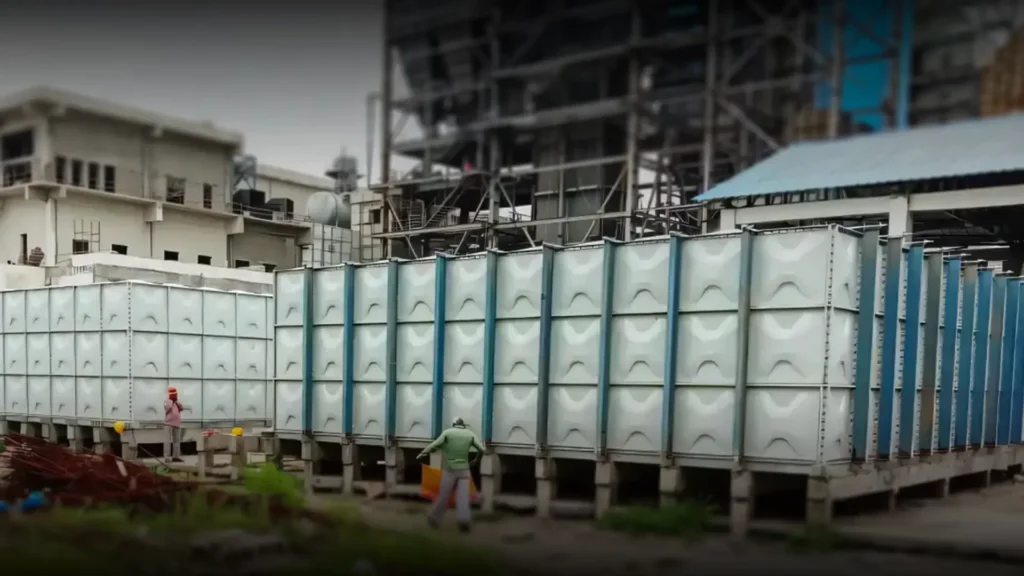
India is entering a new era of water management. With rising population, rapid industrialization, unpredictable climate patterns, and increasing urban demands, the need for advanced water storage solutions has never been more urgent. Traditional methods like concrete tanks and plastic containers are no longer enough to support the growing requirement for reliable, durable, and scalable water storage. This is where innovative storage technologies—such as SMC Panel Tanks, GRP Tanks, Zincalume Bolted Tanks, and Flexi Tanks—are transforming the landscape. These modern systems are helping industries, communities, and governments build sustainable, long-lasting water infrastructure. In this blog, we explore how India’s water storage industry is evolving, the latest trends shaping the future, and why advanced storage solutions are becoming essential. 1. India’s Rising Water Demand: A Growing Challenge India houses 18% of the world’s population but only 4% of the world’s freshwater resources. This imbalance creates pressure on cities, industries, and agricultural regions. Major challenges include: To meet these challenges, the country needs storage systems that offer capacity, durability, quick installation, and long-term performance. 2. Why Modern Water Storage Solutions Are Replacing Traditional Tanks Traditional RCC tanks and plastic tanks are still widely used, but they come with limitations: Modern water storage solutions are engineered to overcome all these limitations. Technologies like SMC, GRP, Zincalume, and Flexi tanks are now preferred for: These trends reflect a major shift in India’s infrastructure planning—towards efficiency, portability, and sustainability. 3. The Rise of SMC and GRP Panel Tanks SMC Panel Tanks SMC (Sheet Moulding Compound) Panel Tanks have become one of the most trusted solutions for industrial and commercial use. They are made from high-strength, food-grade plastic reinforced with fiberglass. Benefits include: Use cases: Factories, hospitals, housing societies, commercial buildings, and institutional projects. GRP Panel Tanks GRP (Glass Reinforced Plastic) Tanks offer excellent durability and hygiene, making them perfect for long-term water storage. Advantages: GRP tanks are especially popular in regions with extreme weather conditions due to their stability and resistance. 4. Zincalume Bolted Tanks – The Future of Large-Scale Storage When it comes to large-capacity storage—such as 50,000 liters to 2 million liters—Zincalume Bolted Tanks are becoming the preferred choice in India. These tanks are made using a special alloy of zinc, aluminium, and silicon, offering unmatched durability. Why Zincalume Tanks Are Gaining Massive Popularity Government departments, private industries, power plants, and large agricultural estates are rapidly adopting these tanks due to their scalability and value. 5. Flexi Tanks – The Smart Solution for Temporary & Mobile Storage Flexi Tanks are one of the fastest-growing trends in India. These collapsible, lightweight tanks offer huge storage capacity at very low cost. They can be installed on any flat surface and used instantly. Key benefits of Flexi Tanks Popular for: Disaster relief, farms, temporary construction sites, industrial projects, and remote locations. With climate change causing irregular rainfall and droughts, Flexi Tanks have become a lifesaver for rural and agricultural communities. 6. Government & Private Sector Adoption: A Boost for Water Storage Technology India’s government departments like CPWD, PWD, Jal Jeevan Mission, Smart City Initiatives, and municipal corporations are increasingly adopting modern water tanks. Private sectors using these solutions include: Such rapid adoption is accelerating India’s infrastructure development and improving water management efficiency. 7. Key Trends Shaping the Future of Water Storage in India ✔ Trend 1: Modular and Prefabricated Tanks Bolted and panel-based modular tanks are replacing traditional fixed tanks due to faster installation and scalability. ✔ Trend 2: Sustainable Materials Eco-friendly tanks such as GRP, SMC, and Zincalume reduce carbon footprint and offer longer life cycles. ✔ Trend 3: Smart Water Monitoring Systems IoT-based level monitoring ensures efficient water usage and helps industries track consumption. ✔ Trend 4: Rainwater Harvesting Integration Businesses and communities are integrating modern tanks with harvesting systems to conserve water. ✔ Trend 5: Rapid Deployment Solutions Flexi tanks and prefabricated tanks support emergency and temporary applications, especially during droughts. 8. Why Companies Prefer Trident Infratech for Water Storage Solutions Trident Infratech has established itself as a trusted name in the water storage industry. With expertise in SMC Panel Tanks, GRP Tanks, Zincalume Bolted Tanks, and Flexi Tanks, the company offers: From CPWD to IIT Delhi, the company has completed major projects that speak for its reliability and engineering strength. 9. The Road Ahead: A Sustainable Water-Secure India The future of water storage in India is moving toward advanced engineering, modular structures, durability, and eco-friendly solutions. With growing global awareness about water conservation, industries and communities are now focusing on cleaner, safer, and more efficient systems. Adopting modern solutions like SMC, GRP, Zincalume, and Flexi tanks can help India: As climate challenges grow, innovative water storage systems will play a key role in securing India’s future. Conclusion India’s water storage landscape is undergoing a major transformation. The shift from conventional tanks to advanced modular solutions reflects a new era of efficiency, sustainability, and technological progress. Companies like Trident Infratech are playing an essential role by providing reliable and future-ready storage systems for industries, communities, government departments, and commercial establishments. With smart planning and innovative technologies, India can build a water-secure future—one tank at a time.
The Role of Bulk Water Storage Solutions in India’s Water Security Strategy
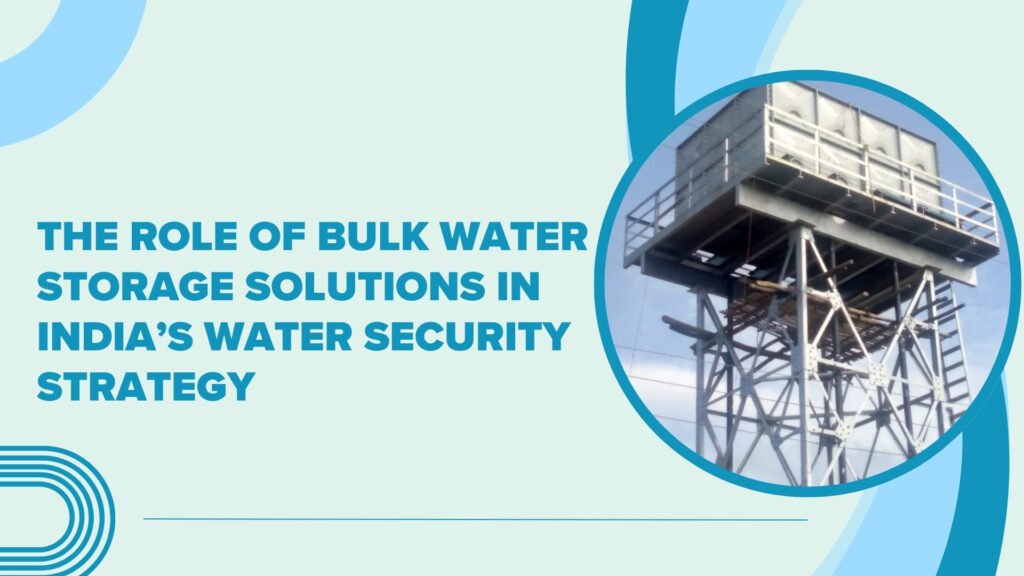
The Role of Bulk Water Storage Solutions in India’s Water Security Strategy India stands at a critical crossroads when it comes to water security. With one of the world’s largest populations and rapidly expanding urban centers, the country faces increasing water scarcity, irregular rainfall patterns, and rising demand from residential, commercial, agricultural, and industrial sectors. In this context, bulk water storage solutions—including modern GRP/SMC panel tanks, modular reservoirs, prefabricated storage systems, and decentralized storage technologies—play a central and strategic role in ensuring sustainable national water supply. This comprehensive article explores how bulk water storage supports India’s water security strategy, why the demand for advanced storage solutions is increasing, and how modern technologies are transforming India’s water infrastructure. 1. Understanding India’s Water Challenge Water security is not simply about the availability of water—it also includes accessibility, quality, reliability, and sustainability. India faces a complex mix of environmental, structural, and socio-economic challenges: 1.1 Uneven Rainfall Distribution India receives nearly 80% of its annual rainfall during a brief monsoon season, leaving long dry periods throughout the year. Poor distribution leads to: 1.2 Rapid Urban Growth Urbanization is increasing at an unprecedented rate. Cities require enormous volumes of water each day for: Without adequate bulk storage, urban water supply systems cannot manage peak demand. 1.3 Groundwater Depletion Groundwater contributes nearly 60% of India’s irrigation and 85% of rural drinking water. However: have made groundwater unsustainable in many areas. 1.4 Inefficient Water Management Traditional storage systems like masonry tanks, old steel reservoirs, and poorly maintained overhead tanks cause: Bulk water storage using modern materials solves these issues by offering better reliability and longer life. 2. Why Bulk Water Storage Is Essential for India’s Water Security Strategy Bulk water storage is a backbone of water management in both urban and rural India. It ensures availability, distribution efficiency, and timely access to stored water during emergencies, shortages, or peak demand. 2.1 Provides Water Security in Non-Monsoon Months Given that India receives a majority of rainfall in a short window, storage systems ensure: 2.2 Supports Government Water Initiatives Initiatives like Jal Jeevan Mission, Swachh Bharat Mission, and Smart Cities require robust water storage for: Large-capacity, modular tanks play a crucial supporting role. 2.3 Ensures Industrial Continuity Industries such as power plants, textiles, food processing, chemical manufacturing, pharmaceuticals, and mining rely heavily on steady water supply for: Bulk storage avoids downtime and production disruption. 2.4 Strengthens Disaster Preparedness In flood, drought, or cyclone-prone regions, storage becomes a lifeline: 3. Types of Bulk Water Storage Solutions Used in India India uses a wide range of water storage technologies, each suited for different applications. 3.1 GRP (Glass Reinforced Plastic) Panel Tanks GRP tanks are becoming one of India’s most popular storage solutions due to: 3.2 SMC (Sheet Molding Compound) Panel Tanks SMC tanks offer similar benefits to GRP tanks but are stronger and can withstand harsh environments. They are ideal for: 3.3 Prefabricated Steel Tanks Used for industrial or agricultural storage where extremely large capacities are required, these tanks: 3.4 Overhead Water Tanks Traditional and modern overhead tanks work as distribution points for: 3.5 Underground Water Tanks Used for rainwater harvesting, firefighting systems, and decentralized storage. 4. How Bulk Water Storage Enhances Water Distribution Efficiency Modern storage systems help maintain consistent water pressure and flow across distribution networks. 4.1 Balancing Peak and Off-Peak Demand Cities experience heavy demand during mornings and evenings. Without storage: Tanks ensure smooth distribution. 4.2 Reducing Wastage and Leakage Modern tanks have: This reduces losses significantly compared to old concrete tanks. 4.3 Enhancing Water Quality GRP/SMC tanks reduce contamination due to: Water remains fresher and safer for consumption. 5. Bulk Water Storage and Rainwater Harvesting in India Water harvesting has become a critical part of India’s water security plan. Bulk storage tanks support harvesting by: 5.1 Capturing Seasonal Rainfall Instead of letting rainwater flow into drains, storage tanks collect: 5.2 Reducing Urban Flooding Storage tanks absorb excess rainwater during heavy showers, reducing: 5.3 Supporting Groundwater Recharge Even when used for harvesting, stored water can later be used for: 6. Advantages of Modern GRP/SMC Bulk Storage Tanks Over Traditional Systems Traditional tanks (RCC, steel, plastic) come with several limitations. Modern storage tanks offer strong advantages: 6.1 Corrosion Resistant Unlike steel tanks, GRP/SMC tanks do not rust or weaken over time. 6.2 Lower Maintenance They require minimal maintenance over decades. 6.3 Lightweight and Easy to Transport Ideal for remote or hilly regions. 6.4 Quick Installation Modular systems can be installed in: 6.5 Cost-Effective Over Long Term Lower maintenance + long life = reduced total ownership cost. 7. Role in India’s Smart Cities and Urban Infrastructure Smart cities require smart water management. Storage tanks support: 7.1 IoT-Enabled Water Levels Advanced tanks support level sensors for: 7.2 Emergency Water Backup Hospitals, malls, and institutions rely on storage during outages. 7.3 Infrastructure Scalability As populations grow, modular tanks can be expanded easily. 8. Bulk Water Storage for Rural India Rural India faces unique challenges such as: Bulk storage helps solve these through: 8.1 Decentralized Water Storage Villages can maintain their own reservoirs. 8.2 Community-Level Distribution Storage tanks support: 8.3 Reduced Dependence on Groundwater Stored water reduces borewell exploitation. 9. Challenges and Opportunities in India’s Bulk Water Storage Sector 9.1 Challenges 9.2 Opportunities 10. Future of Water Storage in India India’s future water strategy revolves around: 10.1 Decentralized Storage Multiple mini-reservoirs prevent system-wide water failure. 10.2 Smart Monitoring IoT and AI-driven water management. 10.3 Sustainable Materials GRP and SMC will replace concrete and steel due to long-term advantages. 10.4 Growth in Prefabricated Systems Faster development in urban and rural regions. Conclusion Bulk water storage solutions are at the heart of India’s water security strategy. As the country faces growing demand, climate challenges, and rapid development, modern storage technologies—especially GRP/SMC tanks—provide a reliable, scalable, and sustainable solution. They empower: In the years to come, bulk water storage will continue to be one of the most important tools in India’s journey toward sustainable water management.
Why Durable Flexi Tanks Are the Future of Water Storage Solutions
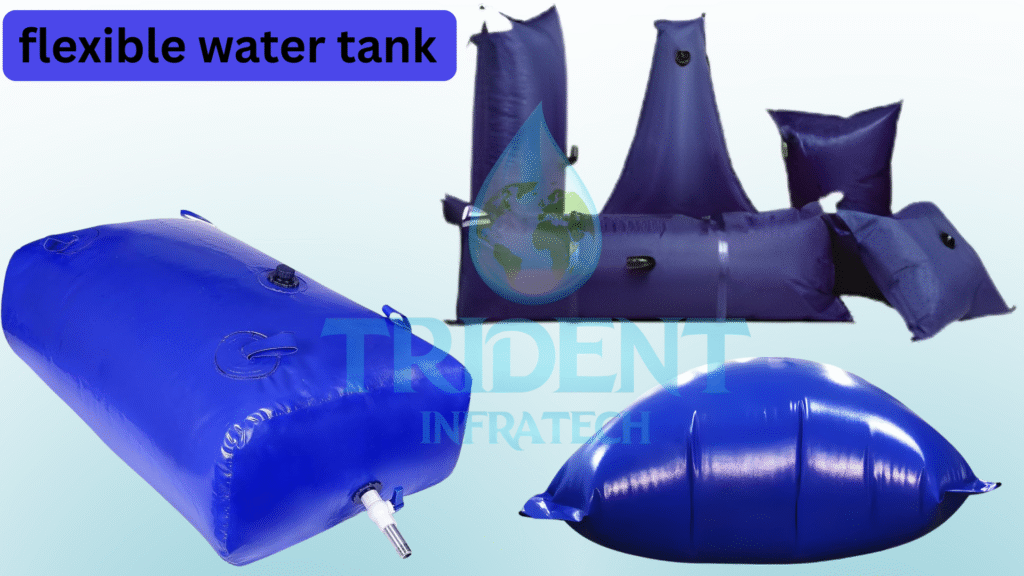
Why Durable Flexi Tanks Are the Future of Water Storage Solutions Introduction: Redefining Water Storage for a Sustainable Future Water is the lifeline of every industry, home, and agricultural system. As population and industrial needs grow, the demand for reliable and space-efficient water storage solutions has never been higher. Traditional water tanks, though widely used, often come with limitations such as high installation costs, rigid structure, and transportation challenges. That’s where Flexible Water Tank Solutions by Trident Infratech are changing the game. These Durable Flexi Tanks offer a smart, scalable, and sustainable alternative to conventional tanks — making them the future of modern water management. Designed with innovation, precision, and quality materials, these tanks ensure you can store large volumes of water safely, efficiently, and flexibly. What Are Flexible Water Tanks? A Flexible Water Tank (or Flexi Tank) is a collapsible water storage container made from reinforced, high-strength polymer-coated fabric. Unlike rigid tanks, flexi tanks can be folded, transported, and installed almost anywhere without requiring heavy foundations or construction work. These tanks are specifically engineered to withstand pressure, UV exposure, temperature variations, and long-term usage — making them perfect for both temporary and permanent water storage. Trident Infratech’s Flexible Water Tank Solutions are designed using industrial-grade PVC, TPU, and polymer fabrics, ensuring durability, leak-proof design, and extended service life. How Do Flexi Tanks Work? The working of a Flexi Tank is straightforward yet highly efficient. It is a sealed, flexible container that expands as water fills it and contracts when emptied. The tanks are equipped with inlet and outlet valves for controlled filling and discharge. Their structure allows easy placement on flat surfaces, without requiring concrete bases. Once emptied, they can be folded and stored compactly — making them a preferred choice for mobile water storage, agricultural irrigation, and emergency relief operations. Key Benefits of Durable Flexi Tank Storage 1. Lightweight and Easy to Transport Unlike bulky steel or concrete tanks, flexible tanks are lightweight and portable. They can be folded and carried to remote or disaster-hit areas, saving both time and logistics costs. 2. Quick and Hassle-Free Installation No foundation or heavy equipment is needed for setup. A Trident Infratech Flexi Tank can be installed in less than an hour, even in off-grid locations. 3. High Durability and Strength Made from reinforced polymer fabrics, these tanks are resistant to punctures, UV rays, and temperature extremes. Trident Infratech’s tanks are tested for long-term exposure, ensuring years of reliable use. 4. Space-Efficient Design Their collapsible structure makes them ideal for areas with limited space. When not in use, they can be folded and stored easily. 5. Cost-Effective and Low Maintenance Compared to rigid tanks, Flexible Water Tank Solutions offer significant savings in terms of installation, transportation, and maintenance costs. 6. Environmentally Friendly The materials used in Trident Infratech’s Durable Flexi Tank Storage systems are eco-friendly and designed to minimize waste, aligning with global sustainability goals. Applications of Flexible Water Tanks The versatility of Flexi Tanks makes them suitable for a wide range of applications across industries: Agriculture Farmers use flexible water tanks for irrigation, rainwater harvesting, and fertilizer mixing. Their portability allows seasonal deployment in fields without permanent infrastructure. Industrial Use Industries rely on Trident Infratech’s tanks for process water storage, chemical solutions, and wastewater management. Their robust build ensures safety against leaks and corrosion. Construction Sites For remote or temporary construction sites, flexi tanks provide a reliable water supply for mixing concrete, cleaning, and worker needs. Disaster Relief and Emergency Use During floods, droughts, or humanitarian missions, Flexible Water Tanks act as quick-deploy storage systems for drinking water and emergency aid. Residential and Commercial Spaces Homeowners and commercial facilities use these tanks for rainwater harvesting, gardening, and backup storage, especially in regions facing water shortages. Flexible Water Tanks vs. Traditional Water Tanks Feature Flexible Water Tanks Traditional Water Tanks Installation Time Less than 1 hour Requires foundation and plumbing Portability Fully portable and foldable Fixed structure Space Usage Compact and collapsible Permanent and rigid Maintenance Minimal Frequent cleaning and repairs Cost Low overall cost High initial and maintenance cost Durability High, weather-resistant Moderate (depends on material) Eco-Friendliness Sustainable materials Often non-recyclable This comparison clearly shows why Durable Flexi Tank Storage is rapidly replacing traditional systems — especially where flexibility, speed, and sustainability matter most. Innovation and Material Quality at Trident Infratech At the heart of Trident Infratech’s success lies engineering excellence and a commitment to quality. Every Flexible Water Tank is manufactured using high-grade polymer-coated fabrics that ensure resistance to UV radiation, chemical corrosion, and microbial growth. Each tank undergoes pressure testing and quality inspection before delivery. The seams are heat-welded for a perfect leak-proof finish. The company also offers custom sizes and capacities, ranging from a few hundred liters to thousands of gallons, meeting diverse customer needs. Trident Infratech’s Flexible Water Tank Solutions are compliant with international water safety and quality standards, making them a trusted choice across India and abroad. Sustainability: A Core Value of Trident Infratech Water conservation and sustainable storage go hand in hand. Trident Infratech takes a green approach in every stage — from design to production. Their tanks support rainwater harvesting, greywater recycling, and efficient water distribution systems, helping reduce environmental impact.Unlike rigid tanks that consume large resources in manufacturing, flexi tanks are made using minimal materials and can be recycled at the end of their lifespan. By promoting Durable Flexi Tank Storage, Trident Infratech is actively contributing to India’s sustainable water management vision. Custom Solutions for Every Sector Understanding that each customer has unique needs, Trident Infratech provides tailor-made Flexible Water Tank Solutions for various industries. Whether it’s a farm irrigation setup, a disaster relief camp, or a large-scale industrial project, the company’s design experts create tanks that perfectly match storage capacity, terrain, and climate conditions. This ability to customize ensures maximum performance, longevity, and safety in every installation. Why Choose Trident Infratech for Flexible Water Tank Solutions Proven Expertise: Years of experience in delivering industrial-grade water storage systems. Quality Assurance: Every
Why Zinc Aluminium Tanks Are the Future of Durable Water Storage Solutions

Why Zinc Aluminium Tanks Are the Future of Durable Water Storage Solutions Introduction – The demand for efficient and long-lasting water storage solutions has grown rapidly in recent years, especially in industries, commercial projects, and large-scale infrastructures. Traditional storage options like concrete, steel, and plastic tanks often fail to deliver the required strength, corrosion resistance, and sustainability that modern industries need. This is where Zinc Aluminium Tanks come into the picture. Combining the strength of steel with the corrosion resistance of aluminium and zinc, these tanks are redefining the future of water storage. Companies like Trident Infratech are leading this transformation by offering superior-quality, bolted Zinc Aluminium Tanks engineered for performance, durability, and sustainability. What Are Zinc Aluminium Tanks? Zinc Aluminium Tanks are advanced water storage systems made using a special alloy of zinc, aluminium, and silicon, often referred to as Zincalume or Galvalume steel. This unique combination ensures exceptional resistance against rust, weather, and chemical exposure while maintaining a strong and lightweight structure. These tanks are typically constructed using modular bolted panels, which makes them easy to transport and install, even in remote locations. Their engineered coating layer provides superior protection compared to traditional galvanised steel or concrete, ensuring long-term performance in harsh environmental conditions. Challenges with Traditional Storage Tanks Before the introduction of Zinc Aluminium Tanks, industries relied heavily on conventional materials like RCC (Reinforced Cement Concrete), mild steel, or plastic. However, these options come with a set of limitations: Corrosion and Rusting: Steel tanks are prone to corrosion, especially when exposed to water and humidity for long durations. Cracking and Leakage: Concrete tanks often develop cracks over time due to thermal expansion and contraction. High Maintenance: Regular cleaning, coating, or replacement increases maintenance costs. Heavy Structure: RCC tanks are bulky, require heavy foundations, and are not easily relocatable. Limited Lifespan: These tanks usually have a service life of 10–15 years before major repairs or replacement are needed. These challenges have made industries search for smarter and more sustainable alternatives—leading to the rise of Zinc Aluminium Tanks. Advantages of Zinc Aluminium Tanks 1. Long-Lasting Durability The unique alloy coating of zinc and aluminium offers four times more corrosion resistance than standard galvanized steel. These tanks can easily last for decades without any structural damage, even in coastal or industrial environments. 2. Corrosion and Weather Resistance The aluminium component forms a barrier against environmental factors like humidity, sunlight, and chemicals, while zinc offers sacrificial protection against scratches or minor damages—making the tanks ideal for all climates. 3. Lightweight yet Strong Despite their strength, Zinc Aluminium Tanks are much lighter than RCC tanks, reducing foundation requirements and transportation costs. Their modular bolted design ensures quick installation without heavy machinery. 4. Easy Installation and Relocation Trident Infratech’s tanks are designed for modular assembly, which means they can be installed, dismantled, or relocated without difficulty—perfect for temporary sites or mobile operations. 5. Eco-Friendly and Sustainable These tanks are 100% recyclable, require minimal maintenance, and produce less environmental waste compared to concrete or plastic tanks, aligning perfectly with global sustainability goals. Applications Across Industries Zinc Aluminium Tanks are versatile and serve multiple sectors efficiently. Some common applications include: Agriculture: For irrigation and rainwater harvesting projects. Industrial Plants: Used for process water, effluent treatment, and storage of raw water. Municipal Projects: For community water supply, fire protection systems, and wastewater management. Construction Sites: Temporary water storage during large-scale construction activities. Food and Beverage Industry: For hygienic storage of potable water and manufacturing processes. Mining and Power Plants: Suitable for dust suppression, cooling water, and other industrial needs. Their adaptability makes them the preferred choice for any sector that demands reliability and long-term water storage. Why Zinc Aluminium Tanks Are the Future 1. Technological Innovation Zinc Aluminium technology represents a major leap forward in water storage engineering. Its ability to resist corrosion, withstand pressure, and maintain strength over decades ensures it will continue to dominate future infrastructure projects. 2. Cost Efficiency While the initial cost might be slightly higher than basic steel tanks, Zinc Aluminium Tanks provide significant savings in maintenance, repairs, and lifespan. Over time, they become the most cost-effective solution for industrial and municipal applications. 3. Adaptability to Climate Change With rising concerns about environmental stress and unpredictable weather conditions, industries require tanks that can perform under varying climates. Zinc Aluminium Tanks are perfectly suited to this challenge, providing dependable performance in heat, humidity, or coastal areas. 4. Sustainability Commitment The world is moving toward sustainable development, and Zinc Aluminium Tanks contribute significantly by being energy-efficient, recyclable, and environmentally responsible. Why Choose Trident Infratech Trident Infratech stands out as a trusted name in the water storage industry due to its commitment to quality, innovation, and customer satisfaction. Here’s why businesses prefer Trident for their Zinc Aluminium Tanks: Proven Expertise: Years of experience in designing and supplying bolted tanks for varied industrial applications. Customized Solutions: Tanks are tailored according to client requirements, site conditions, and capacity needs. High-Quality Materials: Use of premium-grade Zinc Aluminium sheets ensuring superior performance. Efficient Installation: Expert teams ensure quick, safe, and precise installation at any location. After-Sales Support: Dedicated maintenance and technical support ensure long-term reliability. By combining engineering excellence with customer-focused service, Trident Infratech ensures every project meets international quality standards. Comparison: Zinc Aluminium Tanks vs. Other Materials Feature Zinc Aluminium Tanks Steel Tanks Concrete Tanks Plastic Tanks Durability 30–40 years 10–15 years 15–20 years 5–10 years Corrosion Resistance Excellent Poor Moderate Good Maintenance Very Low High Moderate Moderate Installation Time Fast Moderate Slow Fast Weight Lightweight Heavy Very Heavy Light Sustainability 100% Recyclable Limited Non-recyclable Non-biodegradable Relocatable Yes No No Yes This comparison clearly shows how Zinc Aluminium Tanks outperform other materials across multiple parameters, offering superior value and performance. Sustainability and Environmental Impact In today’s eco-conscious world, sustainability plays a critical role in industrial decisions. Zinc Aluminium Tanks perfectly align with green construction standards because: They are fully recyclable, minimizing waste generation. The production process consumes less energy compared to concrete or steel tanks. Reduced
“Revolutionizing Water Storage with Durable SMC Panel Water Tanks by Trident Infratech”

Introduction Water is one of the most essential resources for life and development. In modern infrastructure projects — from high-rise residential buildings to large-scale industrial plants — the need for reliable water storage systems is greater than ever. Traditional solutions like RCC (Reinforced Cement Concrete) or steel tanks often fail to meet modern requirements for hygiene, modularity, and maintenance. Trident Infratech has emerged as a trusted leader in providing advanced infrastructure solutions, and its SMC Panel Water Tanks have revolutionized water storage. These tanks combine modern engineering, superior materials, and modular design to provide long-lasting, durable, and hygienic storage solutions suitable for diverse applications. With Trident Infratech’s tanks, organizations and residential complexes can now enjoy reliable water storage with minimal maintenance and long-term cost efficiency. Understanding SMC Panel Water Tanks SMC (Sheet Moulding Compound) is a composite material made from a carefully engineered blend of polyester resin, glass fibers, and strengthening fillers. This material is highly durable, corrosion-resistant, and lightweight, making it ideal for constructing modular water storage tanks. SMC Panel Water Tanks are constructed from interlocking panels that are pre-fabricated, durable, and easy to assemble on-site. Unlike traditional concrete or steel tanks, these tanks do not require heavy construction work or long curing times. The modular design allows for scalability, meaning tanks can be expanded or reduced in capacity based on project needs. Key advantages of SMC Panel Water Tanks: Hygienic & Non-Toxic: Smooth internal surfaces prevent bacterial growth. Corrosion & UV Resistant: Lasts longer even under harsh weather conditions. Lightweight & Modular: Easy transportation and installation. Low Maintenance: Requires minimal cleaning and inspection. Customizable Sizes & Shapes: Can be tailored to suit residential, commercial, or industrial applications. These features make SMC tanks an ideal choice for sustainable and modern water management, catering to both urban and industrial needs. Key Features and Detailed Specifications Trident Infratech’s SMC Panel Water Tanks stand out due to their technical precision and innovative design. Below is a detailed breakdown: Specification Details Material Sheet Moulding Compound (SMC) Panel Size Customizable, commonly 1m x 1m Panel Thickness 5mm – 20mm depending on capacity Capacity From 1,000 liters to several lakh liters Installation Above Ground / Underground / Rooftop Modular System Temperature Resistance -40°C to +80°C Corrosion Resistance 100% rust-proof and chemical resistant Maintenance Minimal; easy to clean and inspect Applications Residential, Commercial, Industrial, Institutional, Agricultural Additional Product Features: Leak-Proof Design: Every panel is precision-molded to ensure perfect sealing. High Strength-to-Weight Ratio: Panels provide structural stability without the weight of RCC tanks. Fire Retardant Properties: Resistant to fire and extreme heat, adding safety to industrial and commercial setups. Easy Replacement & Expansion: Individual panels can be replaced or added without dismantling the entire tank. Eco-Friendly Material: Reduces environmental impact compared to conventional tanks, aligning with green building practices. Trident Infratech’s tanks undergo rigorous quality checks, including pressure tests, water tightness verification, and durability assessments, ensuring clients receive a reliable and high-performing product. Applications Across Industries with Examples SMC Panel Water Tanks are widely adopted across multiple sectors due to their flexibility, reliability, and long service life. Residential Buildings:High-rise apartments and gated communities require hygienic and leak-proof tanks. Modular SMC tanks can be installed on rooftops or underground, providing safe drinking water to thousands of residents efficiently. Commercial Establishments:Hotels, office complexes, and shopping centers need uninterrupted water supply. Trident Infratech tanks are designed to integrate seamlessly with plumbing systems, ensuring 24/7 availability. Industrial Facilities:Factories and manufacturing plants often require large quantities of water for production, cooling, and cleaning. SMC tanks can handle high-volume storage and are resistant to chemical corrosion, making them perfect for industrial applications. Healthcare and Educational Institutions:Hospitals and schools demand hygienic water storage to prevent contamination. SMC tanks maintain water purity and reduce the risk of microbial growth. Government and Public Projects:Municipal water supply systems, community centers, and emergency water storage benefit from modular tanks that are quick to install and expandable for future capacity requirements. Agriculture and Irrigation:SMC tanks are used for irrigation projects, providing consistent water supply to farms and agricultural initiatives, ensuring water efficiency and sustainability. Case Example:A high-rise residential project in Mumbai replaced its RCC rooftop tanks with SMC Panel Water Tanks. The new system reduced installation time by 60%, maintenance costs by 70%, and provided cleaner, safer water for all residents. Advantages of Choosing Trident Infratech Trident Infratech’s SMC Panel Water Tanks offer unique advantages over conventional water storage systems: 1. Proven Engineering Expertise:The company combines years of infrastructure experience with advanced design principles, ensuring tanks meet industrial-grade quality standards. 2. Reliability and Durability:SMC material ensures long-lasting performance. Trident Infratech tanks are built to withstand environmental stress and heavy water loads without cracking or leaking. 3. Customization and Flexibility:Every project has unique requirements. Trident Infratech can deliver tanks in custom sizes, panel thicknesses, and configurations, making it suitable for any project — large or small. 4. Seamless Installation Support:Professional technicians provide on-site installation guidance, reducing errors and ensuring safe assembly. 5. Cost Efficiency:Modular design reduces labor costs and installation time. The tanks require minimal maintenance, reducing long-term operational costs. 6. Sustainable and Eco-Friendly:Lightweight and recyclable, SMC panels contribute to sustainable construction practices. Reduced material usage and long lifespan lower the environmental footprint. Comparison with Conventional Water Tanks Parameter SMC Panel Water Tanks Concrete / Steel Tanks Durability 25–30 years 10–15 years Corrosion Resistance 100% rust-proof Rust and leak-prone Installation Time Quick modular assembly Long construction and curing Weight Lightweight Heavy, requires strong foundation Maintenance Minimal Frequent cleaning and repair Customization Fully customizable Limited flexibility Unlike concrete or steel tanks, SMC Panel Water Tanks do not crack, corrode, or require extensive maintenance, making them cost-effective in the long run. Industry Case Studies Industrial Manufacturing Plant in Pune:Installed 50,000-liter SMC tanks to store process water. Result: Reduced leakage and maintenance downtime, enabling uninterrupted production. Residential High-Rise in Bengaluru:Replaced multiple RCC tanks with modular SMC panels. Result: Faster installation, safer water supply, and reduced structural load on the rooftop. Government Water Project in Rajasthan:Used SMC tanks for community water storage. Result:
Exploring the Future: Key Trends in Water Storage Solutions for 2025
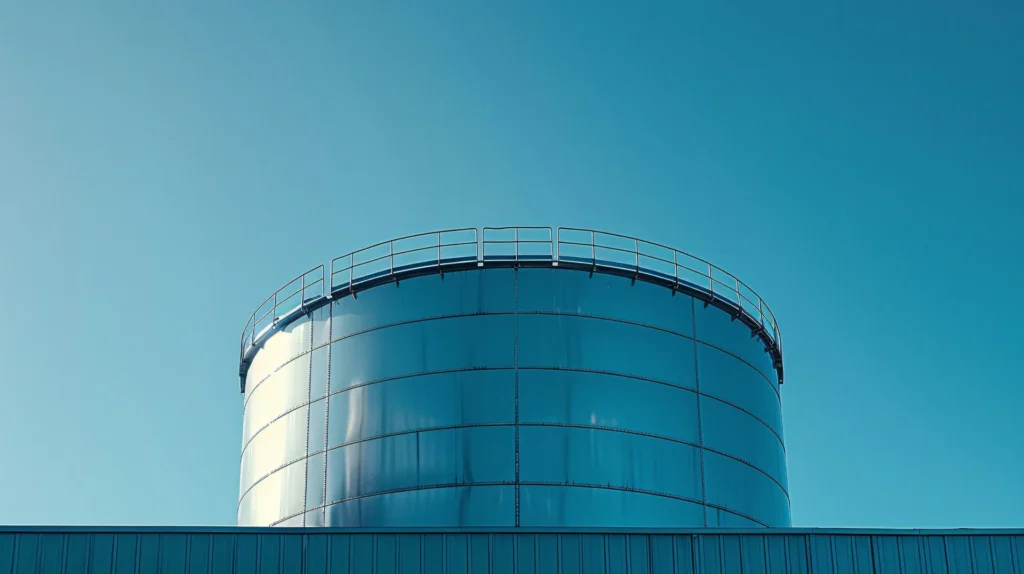
As we forge ahead into an era of increasing environmental challenges, technological advancements, and a growing emphasis on sustainability, the landscape of water storage solutions is poised for significant transformation by 2025. Water scarcity, climate change, and the necessity for efficient resource management have propelled innovation in this field. In this blog post, we will delve into the key trends that are expected to shape water storage solutions in the near future. Smart Water Management Systems One of the most significant trends in water storage is the integration of smart technology into water management systems. With the proliferation of the Internet of Things (IoT), water storage facilities are increasingly adopting smart sensors and analytics. These technologies enable real-time monitoring of water levels, quality, and usage patterns. This data-driven approach facilitates more efficient management and helps identify leaks or inefficiencies, ultimately leading to conservation and cost savings. Sustainable Materials and Designs As sustainability becomes a paramount concern, the choice of materials and design strategies for water storage solutions will shift dramatically. By 2025, we anticipate a greater emphasis on using recycled and eco-friendly materials. Innovations in bioplastics and composites will pave the way for the development of storage tanks that not only minimize environmental impact but are also more durable and longer-lasting. Modular and Scalable Systems The trend towards modular and scalable water storage solutions is gaining momentum. These systems can be easily expanded or reconfigured as demand evolves, making them particularly appealing to municipalities and industries facing fluctuating water needs. Design flexibility not only aids in accommodating growth but also enhances resilience against changing environmental conditions. Rainwater Harvesting and Greywater Systems With the crucial need for water conservation, rainwater harvesting and greywater recycling systems are expected to become more commonplace by 2025. Homeowners and businesses alike are seeking ways to capture and utilize these alternative water sources. The implementation of storage solutions dedicated to these systems will aid in reducing reliance on traditional water supplies and promote a more sustainable approach to water management. Advanced Treatment Technologies In the coming years, there will be a shift towards advanced treatment technologies that enhance the quality and usability of stored water. Innovations such as membrane filtration, UV treatment, and advanced oxidation processes will likely see increased adoption in water storage systems, ensuring that the water stored is not only safe but also suitable for a variety of applications, from irrigation to industrial use. Resilience and Adaptation Planning As climate change impacts intensify, the focus on resilience and adaptation in water storage solutions will be paramount. Facilities will need to be designed with the understanding that extreme weather events and rising sea levels can have profound implications. Strategies will increasingly incorporate considerations for redundancy, flexibility, and adaptability to withstand unforeseen challenges. Conclusion The future of water storage solutions by 2025 reflects a commitment to sustainability, efficiency, and innovation. As we navigate the complexities of resource management amid a changing climate, embracing these key trends will be critical for ensuring that we meet both current and future water needs. Stakeholders in the water sector—including policymakers, engineers, and environmentalists—must work collaboratively to implement these advancements, fostering a resilient framework for water storage that benefits both people and the planet. As we move forward, staying informed about these trends and actively participating in the transformation of water storage practices will help us all contribute to a sustainable future. For further inquiries or discussions about water storage solutions, feel free to reach out to [item]. Together, we can navigate the future of water management.